Pool chemical log best practices: what to record on every visit
A good pool chemical log records what was measured on every visit: the date, the body of water, a consistent set of readings, and a short note for anything unusual. It’s a record, not a dosing recommendation. Even with a handful of customers, a dated reading history builds up into something genuinely useful. It’s proof that a visit happened, it surfaces a pattern that isn’t visible from any single reading, and it gives both sides a paper trail if a customer ever asks a pointed question.
Why a chemical log matters, even for a small route
It’s easy to treat logging as busywork when a route only has a few customers and every visit is still fresh in memory. That changes fast. A dated log is the difference between a confident answer and a guess when a customer asks whether a technician actually showed up on a specific day, and it’s the only reliable way to spot a pattern (a reading that’s drifted over several weeks, for example) that isn’t obvious from any single visit on its own. Memory doesn’t scale past a handful of stops, and a log that only exists in someone’s head disappears the moment that person is unavailable or moves on.
What to record on every visit
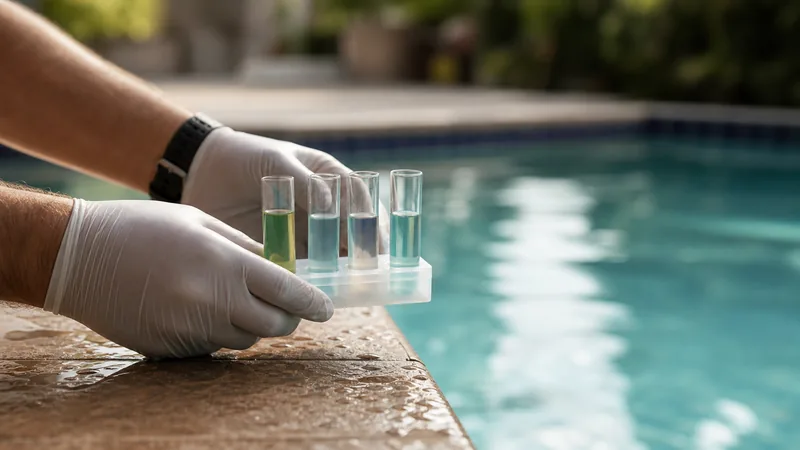
A useful chemical log sticks to a consistent set of fields, visit after visit:
- Date of the visit
- Which body of water, if the property has more than one (a pool and a spa should never share one record)
- pH
- Free chlorine
- Total alkalinity
- Cyanuric acid (CYA), where relevant
- Salt level, for salt-chlorinated pools
- Water temperature
- A short note field for anything unusual: equipment issue, access problem, visible debris, anything worth flagging
This is a record of what was measured on that visit, not a set of instructions for what to do about it. Deciding how to respond to a reading, whether and how much to adjust, is a separate judgment call that belongs to a trained technician working within their state’s rules, not something a log, a spreadsheet, or an app should be automating or prescribing.
Log per body of water, not per property
A property with a pool and a separate spa needs two separate reading histories, not one combined record. The chemistry and service needs of a pool and a spa are different enough that merging them into a single log makes the history harder to read later, and makes it easy to lose track of which numbers belong to which body of water on a given visit. This holds regardless of whether the log is on paper or in software: keeping records separated by body of water from the first visit avoids a cleanup project down the road.
Consistency beats perfection
A log with five basic fields filled in on every visit is more useful than one with eight fields filled in only sometimes. A gap in the record is harder to work around than a slightly shorter set of readings, because a missing entry can’t be reconstructed later with any confidence. If a customer disputes something, or a pattern needs investigating, the value of the log comes from having every visit recorded, not just the visits where something went wrong. It’s worth picking a realistic, consistent set of fields to record every time, rather than an ambitious list that only gets filled in when there’s time to spare.
Small routes sometimes treat logging as optional until something goes wrong. A property manager questions a missed month, a customer switches technicians and asks for the history, a warranty claim on equipment needs a record of water balance over time. None of these situations are common on any single week. Across a year of running a route, at least one of them usually comes up, and a consistent log is the difference between answering it in thirty seconds and reconstructing it from memory.
Paper log vs. digital log

A paper log works fine for one technician and a handful of customers. It gets harder to manage as a route grows: pages get lost, handwriting gets hard to read weeks later, and there’s no easy way to search past readings for a specific property without flipping through a stack of sheets. None of that makes paper a bad starting point. It’s a reasonable way to begin, and plenty of operators run one for a while before it becomes a bottleneck.
A dated chemical reading log tied to a specific visit and a specific body of water solves the scaling problem directly. Readings get tied automatically to the exact stop they were measured on, they’re searchable across the whole customer history, and nothing depends on a page surviving in a truck cab for six months. The switch usually makes sense once a paper log starts costing more time to search than it saves, not on any fixed customer count.
How readings connect to what the customer sees
Readings recorded during a visit don’t need to stay locked away in an internal log. They can show up in the service report a customer receives after a visit, alongside what was done and any notes from the technician, so the customer sees a record of what was measured rather than just a generic “service completed” message. That’s a straightforward way to build trust over time: a customer who can see a consistent, dated history of readings has more reason to trust that visits are actually happening as scheduled, and it gives both sides something concrete to point to if a question ever comes up later.
Keep a dated chemical reading log for every body of water on every plan. See every PoolTechDesk plan to get started.