How to start a pool cleaning business
Starting a pool cleaning business means getting five things right, roughly in order: registering the business and confirming what your state actually requires for licensing, buying enough equipment to do the work without overspending on day one, setting prices before you take a single call, finding your first handful of customers through channels that work in this trade, and building a route system before a notebook or spreadsheet starts breaking down. None of these steps is complicated by itself. Getting the order wrong, or skipping one until it becomes a problem, is what causes most of the trouble.
What it takes to start a pool cleaning business

Before the details, here’s the shape of the whole process:
- Register your business and check your state’s licensing rules
- Buy the equipment you actually need to start
- Price your services before you get your first customer
- Find your first customers
- Set up a repeatable weekly route
- Document every visit from day one
If you’re weighing this against buying an already-running route instead of starting from zero, that’s a real alternative worth looking at. See buying an existing pool route for what that process involves and how it compares.
Register your business and get licensed
Choose a business structure
Most people starting solo begin as a sole proprietorship, since it’s the simplest option and usually doesn’t require anything beyond local business registration to get moving. The tradeoff is that a sole proprietorship doesn’t separate personal assets from business liabilities. If something goes wrong on a job and a claim goes past what insurance covers, personal finances are exposed along with the business’s. An LLC (limited liability company) adds a layer of separation between the business and the owner, and it’s a common step once a route carries real revenue and real equipment on the road. Some owners set one up before the first customer; others wait until the business has grown enough to justify the paperwork and fees. Neither approach is universally right, and this isn’t legal advice. Talk to a local attorney or CPA about which structure fits your state and situation before filing anything.
Check your state’s contractor or pool-service licensing rules
Licensing requirements for pool service businesses vary a lot by state, and the variation isn’t minor. Some states have no separate license for routine cleaning and chemical balancing: register a general business and get to work. Others require a pool contractor or pool service license, and the line between “cleaning” and “contracting” often falls at equipment repair or installation, not at the routine chemical and cleaning visit itself. Some states or counties add their own local registration on top of whatever the state requires. Guessing wrong here isn’t a small mistake. Operating without a required license can mean fines, being barred from certain jobs, or trouble collecting on unpaid invoices if a dispute ever ends up in front of a judge.
We’ve written state-specific breakdowns for Florida and California with the actual requirements we could verify against official sources (linked at the end of this guide). If your state isn’t covered yet, start with your state’s contractor licensing board and your local pool industry association. Both usually publish the actual current rules, not general advice written for a national audience.
General liability insurance
General liability insurance covers claims of property damage or injury connected to your work: a chemical spill that damages a deck or landscaping, a slip near equipment you were servicing, that kind of thing. Most commercial clients, property managers and HOAs will ask for proof of coverage before they sign, and plenty of individual homeowners expect it even when they don’t ask directly. Once there’s a second person on payroll, workers’ compensation typically becomes a separate requirement on top of general liability, with its own state-specific rules.
Cost varies by state, coverage level and claims history, so there’s no reliable single number worth quoting here. Get quotes from an insurer that specifically writes policies for service trades. A generic small-business policy sometimes excludes exactly the kind of work a pool route involves, which only becomes obvious at the worst possible moment, when a claim gets denied.
Buy the equipment you actually need to start
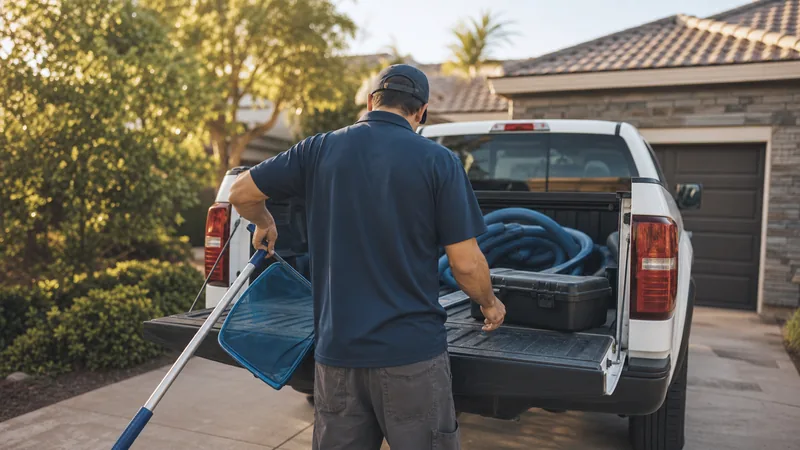
The core toolkit for a residential pool route doesn’t change much between operators:
- A leaf net and a skimmer or telescopic pole
- A pool brush, plus a vacuum head if not every stop runs a robotic cleaner
- A water test kit or digital reader for pH, chlorine, alkalinity and related readings
- A basic supply of balancing chemicals, stored and transported according to your state’s safety rules (this guide covers business setup, not chemical training or dosing)
- A way to carry it all: a truck bed setup, a small trailer, or a well-organized SUV for a very small starting route
- Basic safety gear for handling chemicals: gloves, eye protection, and a spill kit appropriate to what’s being carried
Some routes also need specialty equipment sooner than others. Salt cell pools, for instance, involve different testing and maintenance considerations than chlorine-only pools, and a route with a mix of both needs a tech comfortable switching between them.
Starting lean vs. buying everything upfront
There’s a real argument for starting lean: buy what’s needed for the first handful of customers, used where it makes sense, and reinvest in better equipment as routes fill in. The opposite approach, building out a fully equipped rig before the first customer signs, front-loads cost and risk before the actual route density or customer mix is known. Neither is wrong on its own. What matters is matching spending to how fast stops are actually being added, not to how fast growth is hoped for.
Price your services before you get your first customer
Pricing a pool route comes down to a handful of variables: visit frequency (weekly is standard for most residential routes, though some customers request bi-weekly), the size and type of the water body, how much chemical balancing a given pool needs relative to others on the route, and whether extras like filter cleaning, salt cell service or equipment checks are bundled into the base rate or billed separately. There’s no reliable national average rate worth citing here. Local competition, cost of living and the mix of pool types in a given market all move the number, and publishing a made-up figure would do more harm than good to anyone using it to set their own prices.
What matters more than hitting a specific number is consistency. Once a rate is quoted for a weekly visit with a defined scope, that rate needs to hold unless the scope changes, and any change should be communicated clearly rather than showing up as a surprise on an invoice. It’s a lot easier to keep pricing consistent across a growing customer list when each customer’s rate, frequency and included services live in a service plan that can be referenced at a glance, rather than something reconstructed from memory or an old text thread every time a question comes up.
Find your first customers
A handful of channels consistently work for new pool route operators, especially in the first few months before referrals start doing most of the work:
- Local Facebook groups and Nextdoor, where pool owners regularly post asking for referrals
- HOA contacts: many communities keep a list of approved or recommended vendors, and getting on it can open the door to multiple customers in one cluster at once
- Partnerships with pool builders and real estate agents, who both regularly meet new pool owners at the exact moment they need service
- Door-knocking or flyers in neighborhoods with visible pools, especially near an existing stop. It’s easier and cheaper to add a next-door customer than a cross-town one
- A referral offer for the first few customers: a small credit or discount for a successful referral tends to pay for itself quickly in a trade that runs largely on word of mouth and visible trucks in the neighborhood
Having a simple, consistent way to send a quote helps close these early leads faster than a verbal estimate remembered later. A written estimate with a clear rate and scope, sent the same day as the conversation, converts better than a promise to “follow up.”
Set up a repeatable weekly route

A notebook or a spreadsheet works fine for the first five to eight stops. Past that, the cracks start to show: a missed customer here, a day where the order didn’t make sense and the same street got driven twice, a substitute tech who has no idea what “the usual” means for a given address. None of that reflects badly on the operator. It’s just what happens when a manual system meets a growing number of moving parts and no single record everyone can check.
The fix isn’t complicated: move each customer into a recurring route with a set frequency and day, instead of re-planning the week from scratch every time. Ten to twenty stops a day is a common range for a single tech working a reasonably compact route, depending on drive time and how long each visit runs. A route that’s built once and adjusted only as customers are added or dropped holds up a lot better than one rebuilt from memory or a paper map every Sunday night, and it scales cleanly the day a second technician joins.
Document every visit from day one
Even with two customers, it’s worth logging what happened on every visit: date, readings taken, anything unusual noticed on site, and ideally a photo. It feels like overkill early on. It stops feeling that way the first time a customer asks whether a visit actually happened last week and the answer is a dated record instead of a guess. Documentation habits built from customer one carry forward cleanly as the route grows. Retrofitting them onto fifty customers later is a much bigger project than starting with them from the beginning.
The same logic applies to agreements. A written service agreement template that spells out frequency, scope and rate protects both sides and removes the guesswork about what was actually promised, even for a customer who’s been on the route for years. Waiting until the business has “grown enough to need contracts” usually means retrofitting agreements onto customers who are used to an informal arrangement, which is a harder conversation than starting that way from day one.
State-specific requirements: start with your state
Licensing, registration and insurance requirements genuinely differ from state to state, sometimes significantly, and sometimes in ways that aren’t obvious from a general search. We’re building out state-specific guides one at a time, starting with two of the largest residential pool markets in the country: starting a pool cleaning business in Florida and starting a pool cleaning business in California. If your state isn’t covered yet, check back. We’re adding more.
Once your first customers are signed, PoolTechDesk keeps the route, the agreements and the visit history in one place instead of a notebook, a spreadsheet and a folder of PDFs. See PoolTechDesk's flat monthly pricing. No per-pool fees. No surprise increases as you grow.